Seeberger Sen. Judy Seeberger spoke before the Senate Education Policy Committee on Monday, March 24 on her bill S.F. 1687, which would allow high schoolers to carry opioid antagonists with parental …
This item is available in full to subscribers.
To continue reading, you will need to either log in, using the login form, below, or purchase a new subscription.
If you are a current print subscriber, you can set up a free website account and connect your subscription to it by clicking here.
Otherwise, click here to view your options for subscribing.
Please log in to continue |
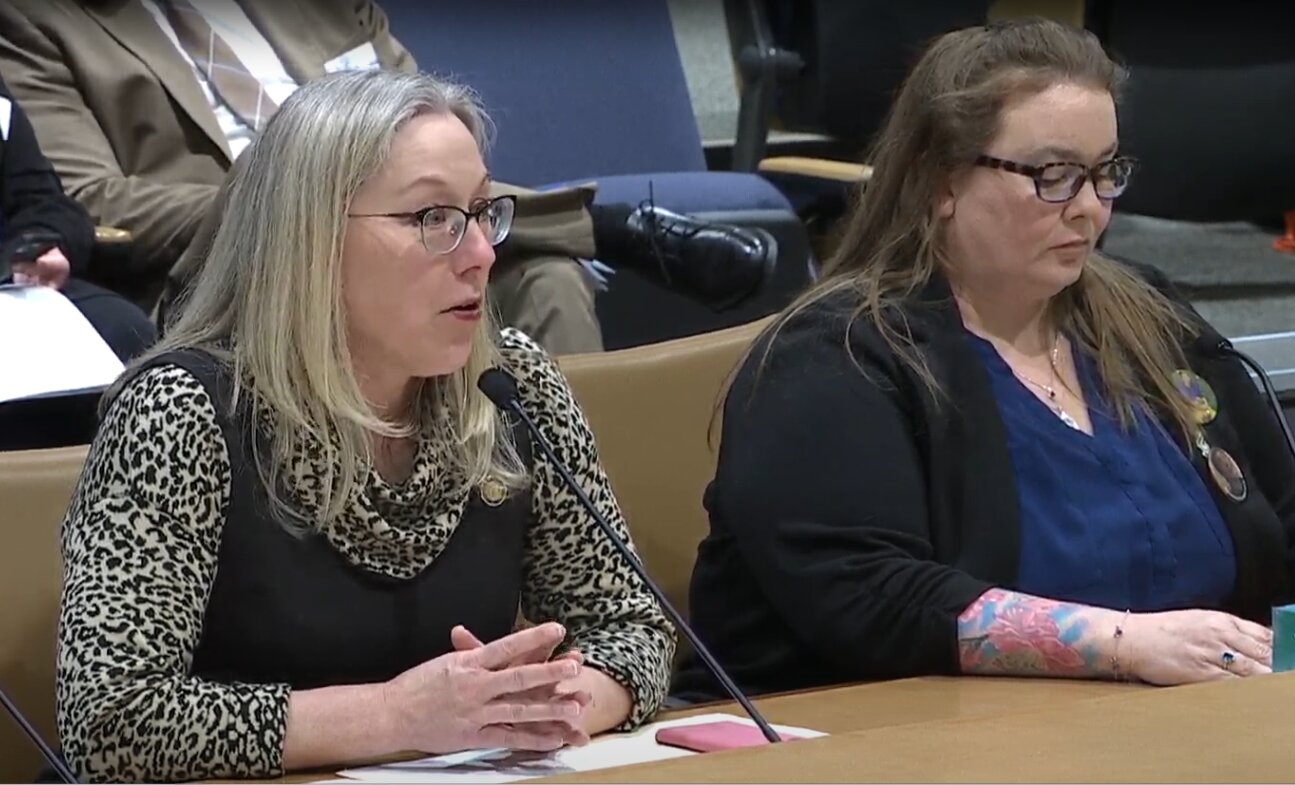
Hastings’ Sen. Judy Seeberger (D-Afton) spoke on Monday, March 24 in the Senate Education Policy committee to her bill S.F. 1687, which would allow high school students to carry opioid antagonists like Naloxone in schools with parental permission.
In the committee, Seeberger referenced the patchwork of school policies with various rules regarding students carrying over-the-counter drugs like Tylenol or Advil. With these policies, students can have opioid antagonists like naloxone or Narcan taken away from them even if their parents want their student to carry them.
“Students that we are educating are having it taken away by school officials because it is still considered an over-the-counter medication,” said Brigette Norring, founder of the Devin J. Norring Foundation and one of the speakers at the committee alongside Sen. Seeberger.
Much of the discussion at Dakota County when it comes to the distribution and proliferation of Naloxone has been focused on simply getting more of it out into the community. At the November 2024 annual opioid settlement annual meeting, Opioid Prevention Program Coordinator James Johnson compared Naloxone to fire extinguishers in that they should be as widely available as possible as a preventative measure: just as one doesn’t plan to have a house fire, one doesn’t plan to respond to an overdose.
“As a paramedic I see it every, every day,” said Seeberger.
Naloxone in particular is known for being easy to use and generally harmless even if given to someone not experiencing an overdose: “You’re not going to harm someone by giving them Narcan,” said Seeberger.
The bill was announced alongside a constellation of similar bills aimed at better informing students about the risks of opioids, overdoses, and social media platforms, on which drugs are often bought.
In the House Education Policy Committee on Wednesday, March 19, representatives discussed H.F. 2023 that would require “overdose prevention education in health education standards,” according to the bill.
The one-sentence bill, outside of definitions, intends to add overdose prevention to the health standards passed in 2024.
Several students including Sofia Templos, a senior at the School of Environmental Studies in Apple Valley, spoke to the importance of this bill.
“In 2023 I experienced first-hand what it was like to watch a family’s life fall apart because their loved one was taken away from fentanyl poisoning. The worst part about this reality is knowing that it is completely preventable,” said Templos.
Another speaker was Dr. Thomas Kottke, a retired professor of medicine from the University of Minnesota.
“When an individual suffers an overdose, I believe it is rarely in the presence of a physician, a firefighter, a police officer or another individual trained in overdose prevention. It is in the presence of peers and friends who would help if they had the knowledge and the skills and the tools,” said Kottke.
When discussing the senate companion bill S.F. 2234, Dr. Kottke made the distinction between the often-used term overdose and the medical term “accidental poisoning.” That distinction is a telling one. Many who die from fentanyl didn’t seek it out. The drug was alleged to be something else, or added for various reasons which contributes to the number of accidental poisoning.
“By educating our youth, we can ensure that in the case of an emergency, people will know what to do when an overdoes occurs,” said Templos at the Monday, March 24 Senate hearing regarding S.F. 2234.
Another bill announced on Friday, March 21, was H.F. 1289 or “A bill for an act relating to consumer protection; requiring social media platforms to post a mental health warning label and timer notifications.”
The bill is chief authored by Rep. Zack Stephenson (D-Coon Rapids) and Rep. Kristin Robbins (R-Maple Grove) and seeks to warn social media users of the potential dangers of protracted use of social media and provide resources to address those concerns.
If passed, the bill would forced social media companies to have a popup when users open the app that details “potential negative mental health impacts of accessing the social media platform,” and provide resources such as the national suicide prevention and mental health crisis hotline system.
In addition, the bill would require another popup at least once every 30 minutes that informs the user of the time they have spent on the app that day.
When speaking about the bill at the event, Rep. Stephenson compared social media to the wide reach of tobacco companies in the mid-20th century:
“I think future Minnesotans will look back at this time the way we look back today on the 50s and 60s for the big tobacco companies. We ask ‘how on earth did they allow cigarette smoking on airplanes?’ We will ask ‘how on earth did they allow teenagers to spend five hours a day on TikTok?’”
Various activists spoke alongside legislators at the event including Suicide Awareness Voices of Education (SAVE) CEO Erich Mische. SAVE is a Minnesota nonprofit that partners with the Keep It Digitally Safe (KIDS) campaign that seeks to raise awareness of the dangers of social media on children and teens.
“Social media has become a maelstrom for kids pulling them into depression, anxiety and suicide,” said Mische.
Beyond the mental health aspect of the bill, several activists spoke to the importance of warnings for teens especially due to the wide availability of purchasing drugs on social media platforms.
One of those speakers was Brigette Norring. Norring’s son Devin Norring was killed by Fentanyl poisoning in 2020 from a drug he thought was Percocet purchased on Snapchat.
“If this law had been in place, if he had seen a warning, maybe he would have thought twice. And just maybe he would be alive,” said Norring.