Get out, stay out, close the door on the way out. Exit as soon as you hear the smoke alarm or see fire, and do not go back inside. That was the message shared at an event Friday, Nov. 21 at the …
This item is available in full to subscribers.
To continue reading, you will need to either log in, using the login form, below, or purchase a new subscription.
If you are a current print subscriber, you can set up a free website account and connect your subscription to it by clicking here.
Otherwise, click here to view your options for subscribing.
Please log in to continue |


Get out, stay out, close the door on the way out. Exit as soon as you hear the smoke alarm or see fire, and do not go back inside.
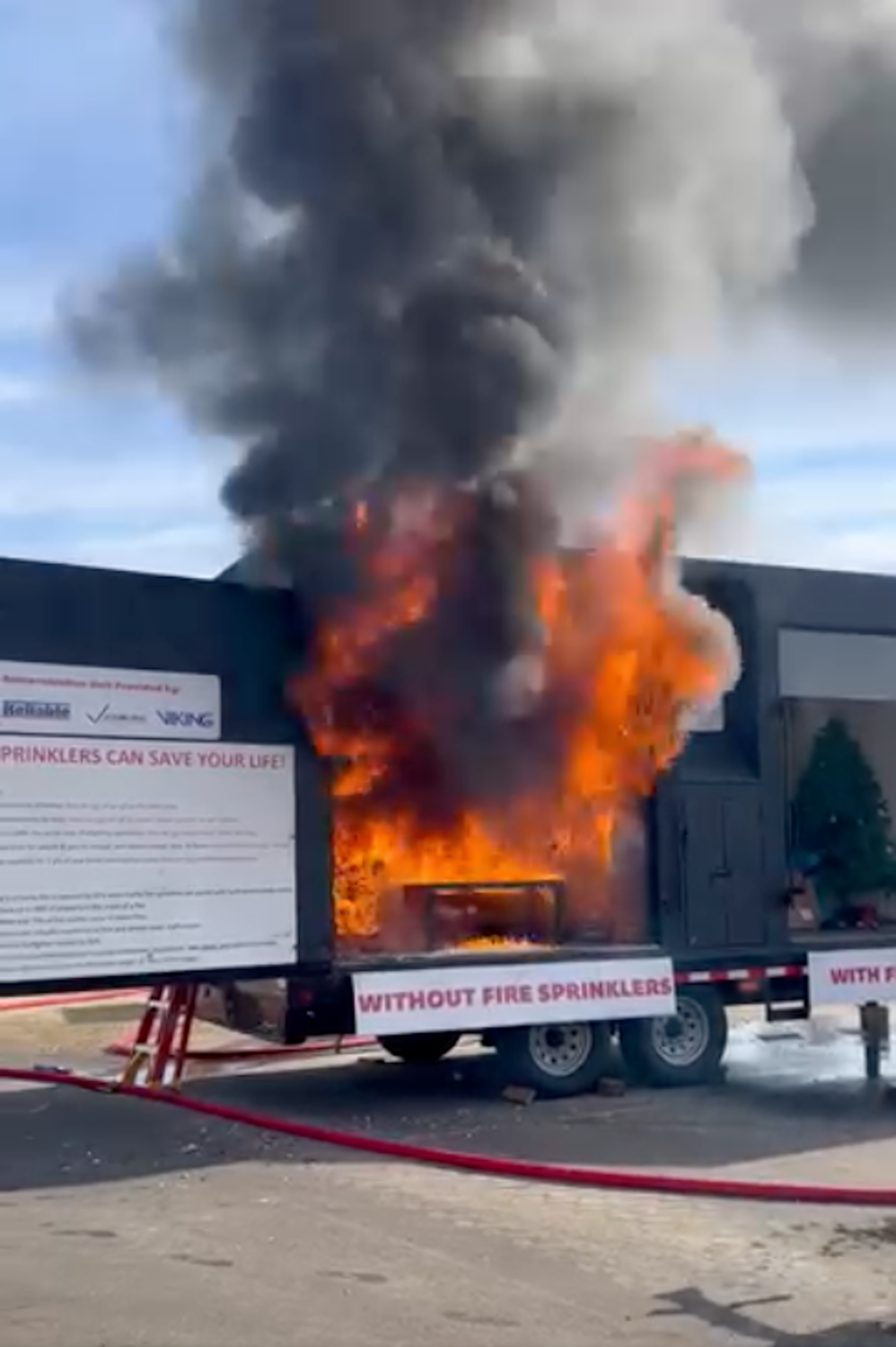
That was the message shared at an event Friday, Nov. 21 at the Cottage Grove Fire Station on 80th Street South to remind people of the holiday fire dangers, put on by the National Fire Sprinkler Association. The gathering last week featured a side-by-side live fire demonstration outside that compared two holiday living room setups — one equipped with fire sprinklers and one without — to show just how quickly fire can spread and how much difference a fire sprinkler system can make. Using an artificial tree and seasonal decorations, the demonstration highlighted the importance of safe decorating and early suppression technology during the holiday season. Among those present at the Friday event were Tom Brace with the Minnesota Chapter of the National Fire Sprinkler Association (NFSA) Minnesota Chapter, Deputy State Fire Marshal Kristy Wisniewski, Cottage Grove Fire Chief Jon Pritchard, area politicians, and fire survivor Steven Mosborg, who shared his story of surviving a Christmas Day fire now 25 years ago.
Feeding the fireplace with wrapping paper back in 2000, Mosborg put a small box into the fire, the box having just enough of an air pocket to catch the live garland on the fireplace.
Getting his wife and daughter to safety outside, Mosborg then went back into the house. Going to the sink for water before trying to put out the fire, Mosborg found it had spread to the drapes and Christmas tree. Thinking that if he could get the tree out he might save the home after having invested heavily in renovating it, Mosborg picked up the tree and tried to move it outside. Due to a change in pressure however he couldn’t open the door. Guided by his wife’s voice to the exit, Mosborg walked over the burning tree and exited via the home’s side door, later transported to the hospital with burns over 63 percent of his body, Mosborg then spent six-and-a-half weeks in an induced coma.
“I never imagined how fast a dry Christmas tree could turn my home into an inferno,” he said. “Within seconds, the fire was out of control. I’m grateful to be alive — many people in my situation aren’t. If sharing my story helps even one family understand the danger and take simple precautions, then it’s worth it.”
Among lessons Mosborg said he learned from the experience were to avoid or be vigilant with live Christmas trees and garland around candles and fireplaces, plan, discuss and practice escape routes, have at least one readily accessible and fully charged fire extinguisher per floor, and that if you can’t put a fire out in the first minute or two, just walk out the door.
“No possessions are worth losing your life over,” he said. “Ever.”
Following Mosborg’s remarks, a live fire demonstration with an artificial Christmas tree and holiday decorations was held outside the fire station, one with sprinklers and another without. The sprinkler system activates closest to the fire only, with each sprinkler sending out 20 gallons of water minute, giving residents time to get outside to safety and call 911.
Deputy state fire marshal Kristy Wisniewski shared important holiday fire safety tips, condensed to a bullet point listing for easy memory:
• Water live Christmas trees daily and dispose of them soon after the holidays.
• Keep candles and space heaters at least three feet away from anything that can burn.
• Turn off holiday lights before going to bed or leaving the house.
• Test smoke and carbon monoxide alarms to ensure they are working properly.
• Never leave cooking unattended — most holiday fires start in the kitchen.
Cottage Grove Fire Chief Jon Pritchard elaborated on Wisniewski’s list of safety tips in more detail.
“The holidays are busy and there a lot of distractions,” he said. “Cooking is the leading cause of fire throughout the year so when we have a lot of distractions, it is even more important to keep any eye on anything on the stove top. When you cook, stay and look.
“We also tend to have more stuff around the house (presents, tables, boxes, etc.) Make sure to keep exit ways clear so you can get out of the house in case of a fire or emergency.
As for specific steps residents can take to help insure their tree doesn’t become a fire risk, Pritchard distinguished natural from artificial trees, each with their own fire risks.
“For natural trees, make sure to water the tree appropriately so it does not become dry,” he said. “Good housekeeping to sweep-up falling needle and keep the tree away (at least 6 feet) from any open fire/heat sources or items that get hot such as candles, fireplaces and space heaters. For lights, check all light cords that they are intact and no broken bulbs. Only use lights labeled as "indoor" lights and use safety tested/verified lights (have a UL tested stamp or similar).
“For artificial trees, keep away (at least 6 feet) from heat sources like candles, fireplaces and space heaters. Use lights that are for indoor use only and use lights that are UL tested or stamped (or similar safety listing). Look at light strands to make sure no fraying or strand damage and all lights are intact.”
Additional tips for fire safety this holiday season include decorating in moderation, with overuse of combustible decorations making a tree more flammable, and being careful with electronic decorations are use in line with manufacturer’s instructions. Never use lit candles on a tree or leave a burning candle unattended. Supervise children and pets around decorations, and don’t place any candles near curtains, bedding, paper, walls, or combustible materials like decorations, window treatments, and paper. Extinguish all candles and make sure the wick ember is no longer glowing before going to another room or to sleep, and use only sturdy, non-combustible candle holders that collect dripping wax and won’t turn over.
Also among tips for fire safety during the holidays are to check light strings when bringing them out of storage for broken or cracked lamp holders, as well as frayed or bare wires and loose connections. Replace any that are damaged with new UL certified light strings. Make sure that light strings are certified and have a gold holographic UL label, with a green UL mark on the tag or near the plug meaning they have been evaluated for indoor use only, while a red UL mark meaning that they have been evaluated for indoor and outdoor use. Always use electric lights in line with manufacturer’s instructions. LED and traditional light Strings that might have large screw-in (C9 and C7) bulbs have different electrical ratings and need to be understood.
As for outdoor decorations, Pritchard said to use only lights listed for outdoor use.
“Use only lights that are listed for outdoor use,” he said. “Check light strands and bulbs for damage. Use safety listed or tested lights (UL stamp). It is a good idea to inspect lights regularly while they are hanging during the holidays especially during extreme cold or winter storms to make sure everything remains intact.
“The holidays get busy and it is easy to forget fire safety with all the business of the holidays. Take some deliberate time on your holiday checklist to make sure your home is fire safe.”
With more home fires between Christmas Eve and New Year’s Day than during any other week of the year, it’s better to be safe, than sorry.