Not permitttable by current statute, or else in need of significant review and FEIS adjustment. That’s the effective consensus of numerous government agencies on a proposed backwater mine in …
This item is available in full to subscribers.
To continue reading, you will need to either log in, using the login form, below, or purchase a new subscription.
If you are a current print subscriber, you can set up a free website account and connect your subscription to it by clicking here.
Otherwise, click here to view your options for subscribing.
Please log in to continue |




Not permitttable by current statute, or else in need of significant review and FEIS adjustment.
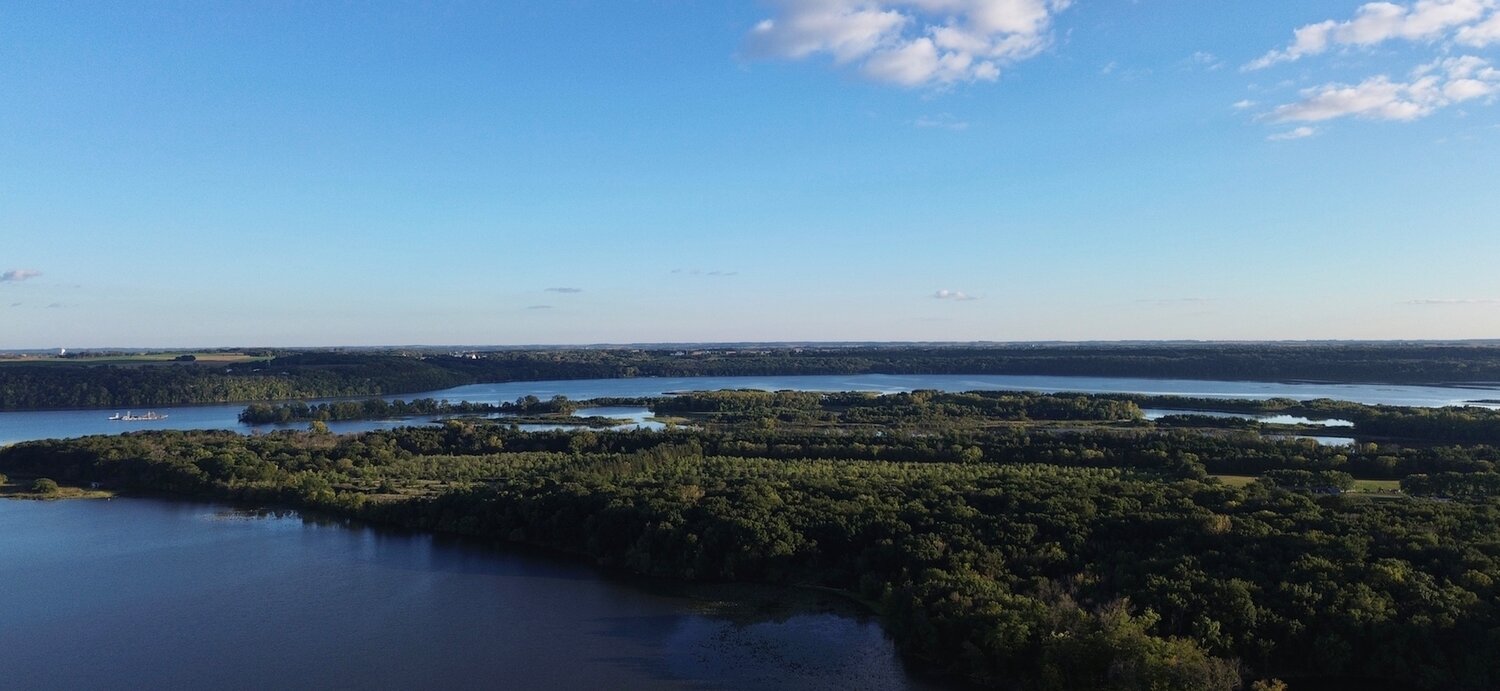
That’s the effective consensus of numerous government agencies on a proposed backwater mine in Pool 2 off Lower Grey Cloud Island, facing pushback from state agencies, area governments, and local residents alike.
Declared “adequate” by the Cottage Grove Council at its Nov. 5 meeting and sent on for review by federal and state agencies before returning to council, the Nelson Backwater Mine Final Environmental Impact Statement (FEIS) includes comment from several government bodies, including the National Park Service, U.S. Army Corps of Engineers, and Minnesota Department of Natural Resources.
Also commenting on the mine are the Metropolitan Council and Dakota County. The mine as proposed would seek to mine an approximately 395 acre area for sand and gravel just south of Camp Galilee off Lower Grey Cloud Island, with mine sites at Lake Baldwin and Coates Township proposed as alternatives.
Offering a comment letter in the Final EIS, Washington County was among many area governments and agencies giving their opinion on the project
Washington County appreciates the opportunity to provide comments on the Final Environmental Impact State (EIS) for the Nelson Backwater Mine Project,” County Planner Daniel Elder wrote for Washington County. “The County values the importance of careful evaluation and transparent communication regarding this project, particularly to give its potential impacts on the local environment, community, and recreational opportunities. The County previously participated as a men oof the Tecbnical Advisory Committee (TAC) and appreciates the opportunity to provide formal comments on the EIS. Our comments only apply to those alternatives presented in Washington County.
Elder then went on to acknowledge city communication and the importance of Lower Grey Cloud Island.
“The County acknowledges the City response the federal consolation under Section 106 would occur during U.S. Army Corps of Engineers permitting,” he wrote. “Given the culture and historical significance of Lower Grey Cloud Island, the County recommends that the RGU continue proactive coordination with affected Tribale Historical Preservation Offices (THPOs) prior to federal consultation.
Key among concerns expressed by Washington County to determine compatibility with long-term park development on Lower Grey Cloud were a detailed reclamation and restoration plan, including “specific design standards for shoreline stabilization, vegetation restoration,’ and visual mitigation of industrial features,” a timeline desired as well for reclamation activities.
That wasn’t all.
“The County reiterates the need for a comprehensive natural resource inventory,” Elder wrote “This would establish a baseline for reclamation and habitat restoration objectives. The County requests that the FEIS include a commitment to conduct the inventory and share results with the county and other relevant agencies. . the County requests the FEIS identify a clear framework for monitoring, compliance, and enforcement.”
Key to this were identification of the lead agency responsible for oversight during reclamation, required frequency and content of progress reports and site inspections, and mechanisms for public transparency.
“The County appreciates that Section 4.15.2 has been updated per previous comments,” Elder writes. “The
County requests continued acknowledgement in subsequent permitting documents that the project area is within the future influence are of a planned regional park, and that visual, ecological, and cultural restoration be aligned with long-term regional park objectives.”
Asking the city to find the Final EIS ‘inadequate’ prior to the council’s Nov. 5 vote meanwhile, the Metropolitan Council laid out its reasoning in an EIS comment letter.
“The Metropolitan Council received the Final EIS for the Nelson Mine Backwater project in the City of Cottage Grove on October 14, 2025,” Local Planning Assistance Senior Manager Angela R. Torres states in part, before showing understanding of the project. “Amrize Midwest Inc. (formerly Holcim and Aggregate Industries ) who own and operates the existing Nelson Sand and Gravel Mine Facility is proposing to increase the mining area to mine additional aggregate reserves on a privately owned parcel adjacent to the existing facility in the backwaters area of the Mississippi River on Lower Grey Cloud Island.
“The staff review finds that the Final EIS is inadequate as defined in Minn. Rules 4410.2800, subpage. 4, with response to regional concerns. Due to potential impacts to Regional Parks and Trails System, the Council strongly advises the City to similarly find the FEIS inadequate and to revise the EIS to address the concerns herein and as stated by other commenting agencies (Minn. R. 4410.2800, subpage. 5).”
Along with nearby parks and cultural resource impacts the Metropolitan Council cited impacts to natural environment and wildlife for the proposed mine
“From a natural environment and wildlife standpoint, the project site is primarily within the Mississippi River ‘backwaters’ and wetlands, an area which supports high-quality aquatic and riparian habitat including wild rice, bulrush, arrowhead, and habitat for an estimated 1.6 million native mussels, fish, and migratory birds (FEIS, pdf pg. 640). Disturbance from construction noise and human activity could cause temporary abandonment of local habitat by birds and mammals (FEIS, pg . 4-167). Similar to other commenting agencies, the Council disagrees with the description of “backwaters” to describe the project area.
“From a water quality standpoint, mining within inundated areas could resuspend sediments and affect turbidity and aquatic life,” Torres wrote. “Barrier berms are proposed to contain suspended solids and prevent migration into the river channel (FEIS pg. 4-82), but Draft EIS reviewers noted insufficient quantitative analysis of sediment generation and water quality effects (FEIS), pdf pg. 679). This additional analysis does not appear to be addressed in the FEIS.”
Torres closed out her remarks by asking that the many issues be addressed.
“Council staff request that the City and proposer fully address issues and concerns raised by Dakota County, the Regional Parking Implementing Agency responsible for Spring Lake Park Reserve and other agencies - including but not limited to the Minnesota Department of Resources and U.S. Army Corps of Engineers. - members of the public who have expressed significant concerns over the proposed mine expansion project. While the FEIS includes responses to agency and public comments, from the perspective of the council it does not fully or sufficiently address the comments.” Quoting Section 116D.04 subd. 6 of the Minnesota Statutes, the Met Council emphasized that:
“No state action significantly affecting the quality of the environment shall be allowed, nor shall any permit for natural resources management and development be granted, where such action or permit has caused or is likely to cause pollution, impairment, or destruction fo the air, water, land, or there natural resources located within the state, so long as there is a feasible and prudent alternative consistent with the reasonable requirements of the public health, safety, and welfare and the state’s paramount concern for the protection of its air, land, and other natural resources from pollution, impairment, or destruction. Economic considerations alone shall not justify such conduct.”
Also providing comment to Cottage Grove on the Nelson Backwater Mine Final EIS meanwhile was DNR Ecological and Water Resources Division Director Katie Smith.
“The city asserts that the ordinances governing the Mississippi River Critical Corridor Area (MRCCA) do not prohibit expansion of nonmetallic mining operations,” Smith writes for comment on the matter. “The city is mistaken.”
“The city’s MRRCA ordinance prohibits the new nonmetallic mining. Nonmetallic mining as ‘construction, reconstruction, repair, relocation, expansion, or removal of any facility for the extraction, stockpiling, storage, disposal, or reclamation of nonmetallic minerals such as stone, sand, and gravel,.’ The definition notably includes ‘expansion’ and ‘relocation.’ The ordinance further explains that ‘facility’ includes all mine pits, quarries, basins, processing structures, equipment, and any structures that drain or divert public waters to allow mining.’” Alternative B includes expansion and relocation to mining within the Mississippi River, as well as construction of new nonmetallic mining facilities within the Shore Impact Zone (SIZ). And the required structure setback from the ordinary high-water level, including (1) a winter slip for the floating dredge unit, (2), a conveyor system for transporting mined aggregate from the proposed mine to the plant, and (3) barrier dikes. These activities are prohibited by the City’s MRCCA Ordinance.”
Going on to reference the City’s citing of Hawkins v. Talbot, Smith says the reference is mischaracterized, in part because the case did not allow expansion without limits.
“The City’s response goes on to reference and mischaracterize Hawkins v. Talbot, the Minnesota Supreme Court case concerning non-conforming uses that involved diminishing assets like quarries, gravel pits, and landfills. 248 Minn. 549 (Minn 1957),” Smith wrote. “In Hawkins, the court recognized that the gravel pit in question was a diminishing asset and its owners did not violate a land use ordinance merely by enlarging the size of the pit. The court went on, however, to explain that its opinion does not mean such assets can be expanded without limits.”
Then turning to analysis, Smith cites the Final EIS for the proposed Nelson Backwaters mine as lacking in analysis with regards to sediment transport, ecological surveys and studies including fish sampling, mussels, and cricket frogs, and rare natural community, as well as mitigation.
“The DNR provided feedback on initial mitigation concepts proposed by Amrize and stressed that purchasing wetland banking credits would not be sufficient to mitigate for the proposed level of adverse impact to a public water,” Smith wrote in part. “Mitigation requirements are dependent on the scale, nature, and location of the impact.”
Smith notes that the Final EIS mentions several general ideas for mitigation but says these are unsatisfactory, with mitigation only coming into play if it was determined that potential impacts from the mine cannot be avoided or minimized.
“The DNR recognizes the need for aggregate resources in the Twin Cities metro area, and as the regulatory authority for Public Waters in the State of Minnesota, it is the responsibility of the DNR to manage our water resources in trust for the benefit of the public,” Smith wrote in conclusion. “DNR must also ensure that these impacts are compatible with applicable state rules and regulations. The Final EIS is lacking with respect to its statement of need/purpose, a meaningful comparison of alternatives, assessment of impacts that are likely to occur due to project implementation, and an clearly defined mitigation concept that addresses those impacts/ DNR must weigh all the environmental, natural resource, legal, recreational, economic, special and institutional impacts when considering whether or not this project can comply with state rules and it pithing the best interest of the public and this natural resource. The DNR will require significant additional information when evaluating permit applicants for Threatened and Endangered Species takings, Wetland Conservation Act, and Work in Public Waters.”
Commenting as well on the Final EIS for the Nelson Backwater Mine is the U.S. Army Corps of Engineers, in the person of Daryl W. Wierzbinski.
“"We appreciate the acknowledgement that the FEIS is being prepared according to the RGU's authority under MEPA," he wrote, MEPA standing for Minnesota Environmental Policy Act. With different state and federal environmental review requirements, the project will be evaluated separately under the federal review process, additional analysis anticipated to satisfy the National Environmental Policy Act (NEPA) as laid out in part 325 of the Code of Federal Regulations, along with Public Interest Review (33 CFR 320.4), and Section 404(b)(1) Guidelines, as contained in 40 CFR part 230.
Additionally, importance of purpose will need to be shown under Section 404 of the Clean Water Act.
"The project is not a water dependent project," Wierzbinski wrote in part for Final EIS comment. "Amrize must rebut the presumption that there is an upland alternative that is less environmentally damaging. The project purpose, defined in the FEIS, limits the range of alternatives to the applicant’s preferred alternative to mining gravel in the Mississippi River. We understand the applicant’s project purpose defined in the FEIS cannot be used for federal permitting, specifically for CWA Section 4040 purposes, as it precludes any off-site alternatives.
We appreciate the opportunity to provide our comments and look forward to continuing to work with the Amrize to develop a permitttable alternative.”
Then giving his contact information, Wierzbnksi closes out by say that, “We look forward to continuing close coordination during review of the proposal.”
Closing out the Final EIS comment review is Dakota County,Washington County’s neighbor to the South which provided a comment letter in the Final EIS laying out its objections to the proposed mine just north of Schaar’s Bluff and the Spring Lake Park Reserve in Dakota County.
“The purpose of this letter is to document Dakota County’s concerns regarding the proposed Nelson Mine Backwaters Project Final Environment Statement (EIS),” County Manager Heidi Welsch writes in part on behalf of the county. “On January 16, 2025, Dakota County submitted comments on the Draft EIS, raising a number of concerns about the project’s impact on the Spring Lake Regional Park Reserve (Park), managed by Dakota County, as well as the general health of the Mississippi River. Upon review, is is apparent the Final EIS is substantially unchanged from the Draft EIS, meaning the the further study, mitigation, and avoidance recommendations made by Dakota County have not been addressed—or even further investigated—by the City of Cottage Grove (as the Responsible Government Unit), or applicant Amrize Midwest Inc. Accordingly, it is the County’s position that the Final EIS, if left unchanged, is both procedurally and substantively inadequate.”
Citing visual (park bluff view) and noise (dredging) while noting its own wildlife and environmental impacts with those of others, the county states that, “The oft recited response in the Final EIS is that these concerns will be addressed in the future permitting process. Again, these concerns are too significant to be disposed of with a cursory ‘wait and see’ response, and are in fact, central to whether the Final EIS is applicable under applicable law.
“The stakes here are high. The mining operation, as proposed, will impact an entire generation of Park visitors, posing the risk to seriously impair a regional natural and cultural resource which the County has invested millions in public funds to develop. The Final EIS completely sidesteps the above comments posed by the County, along with myriad other interested parties concerning the impacts of the proposal. The time to address these matters is now, now some inter determinate time in the future when the momentum of the impact will inevitably create additional challenges. The Final EIS does not take a “hard look” at the concerns raised by the County and other interested parties regarding the impacts raised by the Draft EIS and comments thereto. Accordingly, the County asserts that the Final EIS is inadequate and urges the city to revisit the issues in a more substantive, collaborative manner tallied to the unique resources at risk here.”
Now out for state and federal review, the proposed Nelson Backwater mine will return to the Cottage Grove Council upon permit review completion, being the final government body to say whether the mine proceeds.
A comment request made to Amrize was not returned by press time.